Part Two of Comprehending the Neurological Basics of the Equine
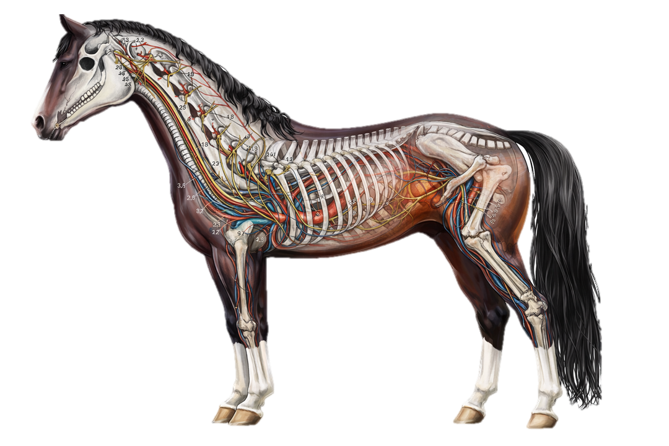
This new comprehension is achieved through studying, questioning, and understanding the anatomy, pathology, and neurological relationships between the animal's orthopaedic stance and the biomechanics of the hoof, as well as the myofascial and postural systems.
To answer these questions and hypotheses, we must first ask ourselves: do we examine individual cells in a localised region, or do we study the interrelationships among the different systems of the animal?
I believe it is best achieved through studying, questioning, and understanding the anatomy, pathology, and neurological relationships, rather than concentrating on individual regions or responses.
"We have to analyse the specific active and characteristic combination of symptoms in different regions of the animal's body, and then analyse the neurological reactions or interplay with the entire body. Allow us to comprehend as to what is the specific involvement in an individual region of the animal's body".
Best achieved non-invasively by simply observing the reflex behaviour of the entire animal, and monitoring the responses to a specific treatment performed. Then observe the neuromotor signals that cumulate in the animal's consistently occurring response action.
Science has now concluded that a key concept in understanding the nervous system is that the individual neuron, with its dendrite branches at one end and its long axon at the other, is the elementary unit of the neurological system.
The axon conveys neural responses (electrical signals), serving as the neuron's transmitting component. The component that conveys the signal via the axon is called the action potential, a zone that conducts the signal. The action potential zones, specialised trigger points near the axon's origin (top).
The brain receives these signals, then analyses them and retransmits the information along the nervous system to the part of the body that requires the neuromotor response (movement). The thing about these action potentials is that their impulse signal is either full on or none.
It is the nervous system (nerve cells) that must convey sensory signals to the brain about environmental events that affect the body, such as mechanical pressure, olfactory stimuli, and light.
However, it would be remiss of us to say that the muscular system controls the movement throughout the body via the mechanical leverage theory. The individual muscles that attach to the skeletal system are united by a seamless integration of connective tissue that serves as a regulatory system for the animal's complex biological system.
It is these elements that we influence whenever we trim, shoe or interact with our horses, and these interactions affect their overall movement and balance. I will continue to discuss this subject in the next posting.


Comments