The Internal Workings and Orthopaedic Balance of the Distal Interphalangeal Joint in Equines

Understanding Structure, Function, and Clinical Significance
The distal interphalangeal joint (DIPJ), commonly known as the coffin joint, is a crucial structure in the equine limb. Its proper function and balance are essential for soundness, athletic performance, and the overall health of the horse's foot, upper body and nervous system. This document provides an in-depth explanation of the internal workings and orthopaedic balance of the equine DIPJ, integrating anatomical, biomechanical, and clinical perspectives.
Anatomy of the Distal Interphalangeal Joint
The DIPJ is located between the middle phalanx (second phalanx or short pastern bone) and the distal phalanx (third phalanx or coffin bone), with the navicular bone (distal sesamoid bone) forming part of its articular surface. Articulation of the joint occurs mostly between the condylar parmar surfaces of the middle phalanx and the proximal articulating surface of the navicular bone, and is influenced heavily by DIPJ imbalance and upper body compensantion patterns. A strong, fibrous joint capsule surrounds the joint and contains synovial fluid for lubrication.
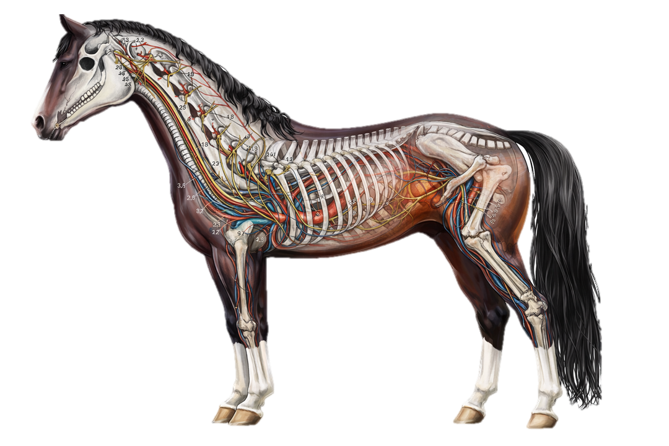
When the DIPJ balance is challenged, it triggers a neurological response that is relayed to the entire body, leading to upper-body compensatory patterns that influence orthopaedic loading of the individual limbs, thereby affecting the tendon and ligament alignment of the distal joints.
· Bones: Middle phalanx, distal phalanx, navicular bone
· Cartilage: Articular cartilage covers the bone surfaces, permitting smooth movement in a three-dimensional plane
· Ligaments: Collateral ligaments (medial and lateral), dorsal and palmar ligaments, and the distal impar sesamoidean ligament (connecting the distal phalanx to the navicular bone)
· Joint Capsule: Encloses the joint, providing stability and containing synovial fluid.
The DIPJ is a hinge-type synovial joint that permits flexion and extension with a small range of lateral and rotational movement; it is a three-dimensional joint. Its function is closely integrated with the surrounding soft-tissue structures and the nervous system, including the deep digital flexor tendon (DDFT), extensor tendon, digital cushion, distal cartilages, and the hoof capsule.
· Deep Digital Flexor Tendon (DDFT): Passes over the navicular bone and attaches to the palmar surface of the distal phalanx, exerting flexion forces on the DIPJ.
· Extensor Tendon: Attaches dorsally, extending the joint
· Navicular Apparatus: Includes the navicular bone, bursa, and associated ligaments, acting as a fulcrum for the DDFT and distributing load through the common digital flexor muscle in the upper body
· Digital Cushion and Hoof Capsule: Absorb concussion and aid in shock distribution, and their shape and functional properties are only the end product of the orthopaedic loading of the individual limb with respect to the forces experienced in the upper body
· The Hoof Capsule acts as the supporting structure for the distal phalanx and helps the DIPJ absorb the different loading forces of the body and the reactional forces of the ground.
· When the DIPJ is compromised by whatever means, then the gravitational forces on the body will influence the body's centre of mass and, therefore, the centre of pressure transmitted to the ground.
· The centre of pressure on the ground is the influencing factor for the placement of the individual limb and orthopaedic balance of the DIPJ and external hoof capsule shape.
Joint movement is facilitated by the synovial fluid, which reduces friction and nourishes the articular cartilage. The ligaments and joint capsule provide lateral and rotational stability, preventing excessive motion that could lead to injury and early biological changes, thereby maintaining flexibility, mobility, and stability.
Orthopaedic balance refers to the alignment and distribution of forces through the joint and its supporting structures. Proper balance is critical for even load-sharing, optimal joint function, prevention of lameness or degenerative joint disease, and the prevention of compensatory patterns in the upper body. The health of not only the tendons and ligaments is compromised with an imbalance in the orthopaedic loading of a limb; however, the neurological system will alert the entire body to the forces of imbalance.
Factors Affecting Balance
· Hoof Conformation: The angle and shape of the hoof influence the alignment of the DIPJ; however, the imbalance of the hoof capsule indicates the imbalance of the DIPJ. A well-balanced foot enables even weight distribution across the joint surfaces, particularly at the articulation of the navicular bone and the flexor surface of the deep digital flexor tendon (DDft).
· Limb Alignment: Deviations (such as toe-in, toe-out, or club foot) alter the biomechanics of the DIPJ, potentially leading to uneven wear or strain on ligaments and cartilage. It is also the primary factor determining the correct or incorrect swing phase and loading phase of the limb and foot.
· Shoeing and Trimming: Farriery practices have a significant impact on DIPJ balance. Correct trimming and shoeing maintain the appropriate hoof-pastern axis and support the joint. Incorrect trimming or shoeing practices lead to a compensatory reaction of the DIPJ, influencing the upper body through imbalanced tendon and ligament systems.
· Musculoskeletal Health: The strength and flexibility of tendons and ligaments contribute to joint stability and resilience to mechanical stress. Farriery practices influence the biological makeup of tendons, ligaments, and cartilages, as well as the animal's postural stance, both in the short term and long term.
Clinical Implications of Imbalance
Imbalances in the DIPJ can lead to a range of orthopaedic problems, including:
· Osteoarthritis and degenerative joint disease
· Navicular syndrome
· Collateral ligament desmitis (inflammation of a ligament)
· Hoof capsule distortion and laminitis
· Upper body compensation patterns and inappropriate spinal alignment
· Vascular infusion of the distal limb and foot
· Distal proper palmar nerve pressure influences and delays the signals to and from the central nervous system
Early detection and correction of imbalance—through regular assessment, appropriate farriery, and management—are essential for maintaining long-term soundness in equines.
Conclusion
The distal interphalangeal joint in horses is a complex structure whose internal workings depend on the harmonious interaction of bones, cartilage, ligaments, tendons, and the hoof capsule. The orthopaedic balance of this joint is vital for even load distribution, efficient movement, and prevention of lameness. A thorough understanding of these principles is essential for veterinarians, farriers, and horse owners alike to ensure optimal equine health and performance.
To understand the complex workings of the DIPJ and the reactional orthopaedic balance of the distal limbs requires an in-depth examination of distal tendons, ligaments, cartilages and other soft tissue structures to allow the comprehension of the presenting external shape of the hoof capsule, as it is only a product of the loading properties, strength and shearing forces it is experiencing at any moment in time.

Comments